

Anonymous VPS Hosting: A Practical Privacy Buying Guide
Evaluate VPS privacy across your account, payment, infrastructure, application, and backups. Learn which questions turn broad privacy claims into clear require

Anonymous VPS hosting usually describes a server purchased with fewer identity requirements, privacy-oriented account practices, or cryptocurrency payment. It does not automatically mean that no records exist or that the customer is untraceable. To choose well, compare what information is collected, who can access it, how long it is retained, and what your application exposes publicly.
For many businesses and independent developers, the practical goal is straightforward: run an application without sharing more personal information than necessary. That requires a clear understanding of the hosting service, payment process, and server configuration.
This guide provides a framework for evaluating those choices. You can explore REGXA's anonymous VPS offering, while using the provider's current policies to understand the actual privacy conditions.
What does “anonymous VPS” really mean?
The term has no single feature checklist across hosting providers. One service may omit document checks during ordinary signup. Another may accept crypto but still collect standard billing details. A third may restrict particular traffic logs while retaining account access and abuse records.
Treat the label as the beginning of your research. Ask the provider to define its terms in writing, especially when the headline and the privacy policy seem to describe different practices.
Term | What it may describe | What it does not establish |
|---|---|---|
No KYC or no document verification | Identity documents are not requested in a stated purchasing flow | That no account information is collected or no later review can occur |
Crypto payment | The service accepts a cryptocurrency payment method | That the transaction or payer is anonymous |
No logs | Certain records are not retained, according to a defined policy | That every account, network, application, and support record is absent |
Offshore hosting | Infrastructure is located outside a particular customer's country | A universal exemption from rules or legal requests |
Domain privacy | Certain registration details are withheld from public directory output | That the registrar has no customer information |
These distinctions help you compare services on what they do, rather than on how strongly their marketing promises privacy.
Define the information you want to protect
Start with a specific question: what information are you trying to keep from unnecessary exposure, and to whom?
A developer may want to avoid publishing a home address alongside a project domain. A company may need to restrict who can read customer records. A small team may want project access to stay separate from employees' personal accounts. Each goal needs different controls.
Use this simple planning table before choosing a server:
Privacy goal | Useful control to evaluate | Evidence to look for |
|---|---|---|
Limit unnecessary account data | Minimal required fields and a clear collection policy | Signup requirements and written policy |
Protect administrative access | MFA, individual accounts, and restricted remote access | Available settings and a tested recovery process |
Keep application data confidential | Access control, encryption, and restricted backups | Application configuration and access review |
Reduce public contact exposure | Appropriate domain privacy or redaction | The selected extension's registration output |
Control retained records | Defined logging purposes and retention periods | A policy that identifies record categories |
Preserve service continuity | Recoverable accounts, funded renewals, and backups | A working restore and recovery test |
This is a decision worksheet, not a privacy certification. You can use it to identify gaps before putting important data on a server.
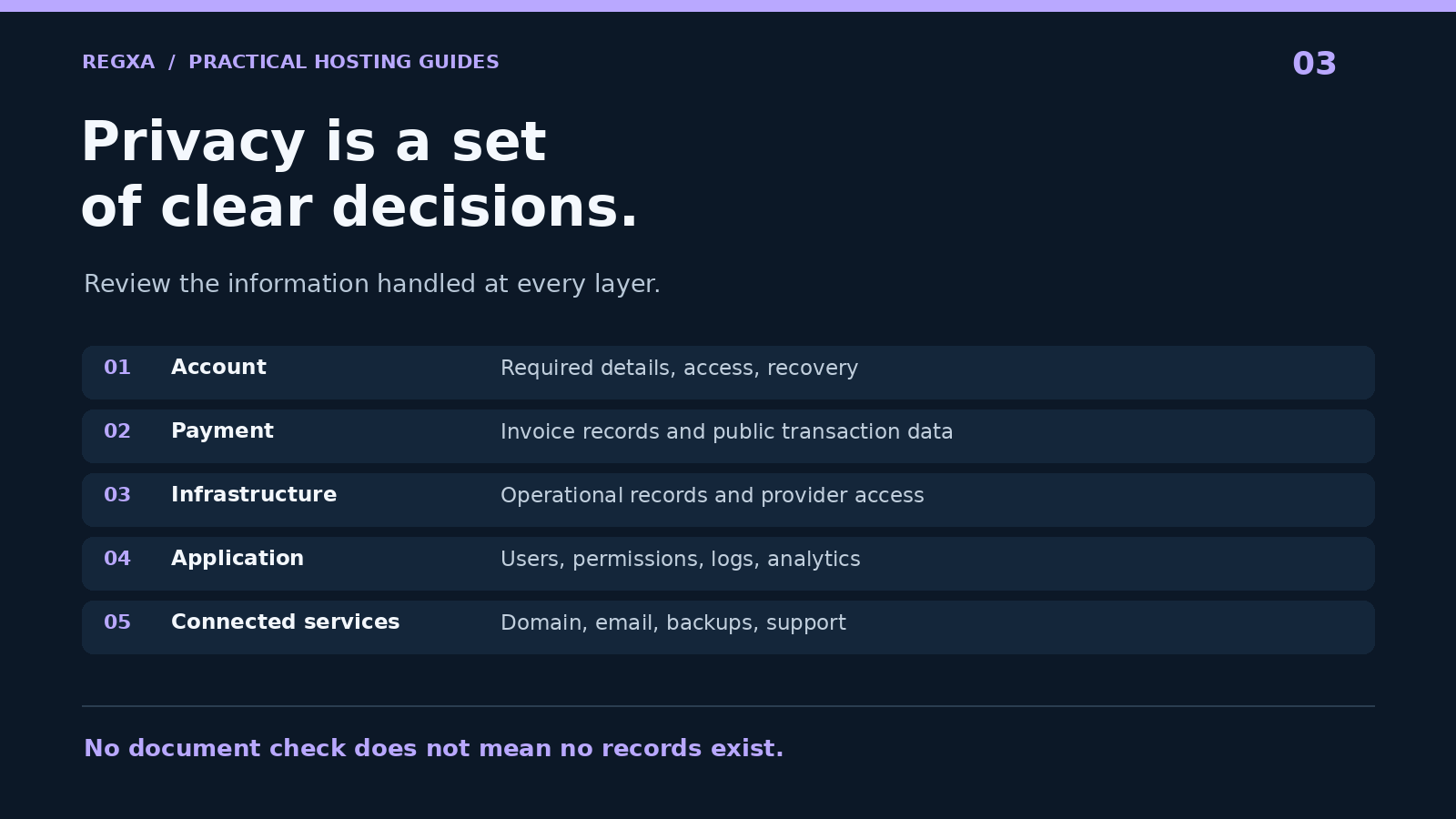
Evaluate privacy across five separate layers
1. The hosting account
Review the information required to register, obtain support, recover access, and pay an invoice. Ask whether requirements differ for a normal order, suspected fraud, account recovery, or a particular service.
A working contact address matters. If renewal notices or recovery messages cannot reach you, a privacy choice can become a service continuity problem. Prefer an account you can maintain securely over a disposable address you may lose.
2. The payment record
Bitcoin payments use a public ledger. Addresses and transaction history can become connected to other information, so paying in BTC should not be treated as a promise of anonymity. Bitcoin.org's privacy documentation explains this distinction.
Ask what the payment processor receives and what the hosting provider retains with the invoice. An account credit may also create an ongoing billing record even when no card is used.
3. The infrastructure
Read which operational records the provider collects: for example, account access, service configuration, performance data, support correspondence, and security events. A provider can limit some records while keeping others for service operation.
Ordinary virtual hosting still involves trust in an infrastructure operator. Encryption and careful configuration can reduce exposure, but the phrase “encrypted VPS” is too broad to evaluate without knowing what is encrypted and who controls the keys.
4. Your operating system and application
The guest operating system and application may create their own logs, independent of the hosting provider. Web servers, analytics scripts, error reporting services, and authentication systems can all retain information about visitors or users.
Decide what your application needs to record. Avoid collecting sensitive request bodies, secrets, or unnecessary personal data in routine logs. Limit access and set retention periods appropriate to each record's purpose. Preserve the records required to diagnose security and reliability problems.
5. Domains, email, and backups
Privacy can be affected by systems outside the VPS. Domain registration, email delivery, third-party storage, and support attachments each have their own data handling.
For domain names, privacy and proxy services are distinct arrangements. ICANN explains their roles in its privacy and proxy service guidance. Check who is the registered holder and what information is publicly displayed.
Apply the same care to backups. A protected production application can still expose data through an unrestricted backup location or a shared download link.
How to assess a provider's “no logs” claim
Ask what “logs” means in the claim. Does it refer to traffic contents, network flow metadata, website visits, control panel logins, or everything together? Those are different records with different purposes.
A useful response should identify record categories, retention periods, access restrictions, and exceptions. It should also describe how a customer can ask questions about data handling.
For REGXA specifically, the published Privacy Policy identifies contact and billing information, IP addresses and access logs, service metrics, and infrastructure monitoring data. Read those details when assessing whether the service meets your needs. Crypto checkout alone should not be interpreted as a commitment that all records are absent.
If privacy is a purchase requirement, get any unclear point resolved before paying. A precise explanation is more useful than an absolute slogan.
Choose server location for the whole project
Location affects network performance, data handling arrangements, and who operates the infrastructure. Identify the contracting entity, the server region, and any external services your application relies on.
Compare locations against your users' connectivity needs and your own data requirements. Avoid assuming that a region is automatically suitable simply because a provider calls it offshore. Your application, your customers, and the parties handling data all matter.
For a business with specific contractual or regulatory requirements, ask for the relevant service terms and data processing information. A product label is not a substitute for checking those obligations.
A practical privacy setup for a new VPS
After deployment, make privacy part of ordinary server administration:
- Secure the hosting account. Use a unique password, available MFA, and a recovery method controlled by the project owner.
- Separate user permissions. Give team members individual access with the permissions their tasks require.
- Restrict management interfaces. Keep SSH, RDP, and administrative panels accessible only through the intended access path.
- Encrypt traffic and protect secrets. Use TLS for the application and avoid storing credentials in public repositories or support screenshots.
- Review the information your application records. Check analytics, error reports, web logs, and database exports.
- Protect backups independently. Restrict access, consider encryption, and test a restore.
- Document retention and removal. Include third-party services and backup copies in the process.
Keep a recovery route available when changing authentication or network rules. Privacy controls should remain operable when the primary administrator is unavailable or a laptop is lost.
An example: a small team's private project workspace
Imagine a three-person team hosting an internal project application. Its goal is to prevent public access to project files and reduce unnecessary personal information in administrative records.
The team chooses a suitable server region, creates named accounts, restricts administrative access, and places the application behind its intended authentication layer. It disables unnecessary analytics and makes sure error reports do not include uploaded documents. Backups go to restricted storage, and one team member verifies that a file can be restored.
For billing, the team chooses a payment method it can reconcile and renew reliably. It retains the business records it needs and reads the provider's collection policy.
This hypothetical example demonstrates a useful result: defined information, limited access, and recoverability. None of those outcomes depends on claiming that the server is impossible to trace.
Privacy hosting still has operating rules
Review the provider's acceptable use policy and account terms. Privacy-oriented purchasing does not authorize spam, malware distribution, attacks, or infringement. It also does not imply that a provider ignores valid requests or never investigates abuse.
For REGXA, consult the Acceptable Use Policy and Terms of Service. These documents are relevant to any VPS order, regardless of payment method.
Frequently asked questions
Is anonymous VPS hosting completely untraceable?
No ordinary hosting label establishes that. Account information, public payment records, application activity, and third-party services can create connections. Evaluate the specific privacy properties you need.
Does no KYC mean the provider collects no information?
No. A document-verification policy is separate from account data, billing records, access logs, and support history. Ask which information is required for your order and how it is handled.
Can I use anonymous VPS hosting for a legitimate business?
Yes, privacy-conscious businesses can use VPS hosting for permitted applications. The important questions are whether the service meets the business's data, support, reliability, and contractual requirements.
Does paying with Bitcoin hide my identity?
It lets you pay without a card when supported, but it does not guarantee anonymity. The blockchain and the hosting account are separate sources of information.
Is a VPN the same as an anonymous VPS?
No. A VPS is a server you operate. A VPN provides a particular network connection service. Running or using a VPN does not replace application security, account controls, or a provider privacy review.
How should I compare REGXA's privacy offering?
Review the selected VPS configuration, signup requirements, Privacy Policy, and account terms together. Ask support to explain any difference between a product headline and the policy that applies to your service.
Choose privacy you can define and maintain
The strongest buying decision starts with specific requirements: what information you need to protect, what each provider collects, and how you will operate the server. Clear policies, limited access, and recoverable systems make those requirements practical.
Review REGXA's anonymous VPS options alongside its Privacy Policy to assess the fit for your project.
Related Topics
Anonymous VPS Hosting: A Practical Privacy Buying Guide